
Andrea Kiewel, often affectionately known as “Kiwi,” stands out as one of Germany’s most enduring and beloved television presenters. With her infectious energy and warm smile, she has captivated audiences for decades, turning Sunday mornings into joyful gatherings through her flagship show. From her roots in competitive swimming to her current role as a household name, Andrea Kiewel’s journey is a testament to resilience, passion, and the power of connecting with people. In this article, we’ll dive deep into her life, exploring how she’s become a symbol of optimism and entertainment in German media. Whether you’re a longtime fan or just discovering her, there’s plenty to admire about this dynamic personality who continues to inspire at every turn.

Andrea Kiewel in 2005, showcasing her signature bright smile during a hosting gig.
As we look ahead, Andrea Kiewel story reminds us that with determination and a positive outlook, anyone can overcome challenges and shine brightly. Her contributions to television not only entertain but also bring people together, fostering a sense of community that’s sorely needed in today’s world.
Early Life and Athletic Beginnings
Growing up in East Berlin during the days of the German Democratic Republic, Andrea Kiewel entered the world on June 10, 1965, as Andrea Mathyssek. Life in the GDR wasn’t always easy, but it shaped her into the strong-willed individual she is today. From a young age, she showed a knack for sports, particularly swimming, which became her first true passion. Attending the Werner Seelenbinder Children’s and Youth Sports School in Berlin-Alt-Hohenschönhausen, she honed her skills and quickly rose through the ranks.
By the late 1970s and early 1980s, Andrea was making waves—quite literally—as part of the GDR’s youth national swimming team. Representing SC Dynamo Berlin, she achieved notable successes, including a gold medal in the 4x100m medley relay at the 1979 Spartakiade. In the following years, she snagged podium finishes at the DDR Championships: third in the freestyle relay in 1980, second in both freestyle and medley relays in 1981, and a championship win in the freestyle relay alongside a silver in medley in 1982. Her best solo performance? A respectable sixth place in the 50m freestyle at the 1982 nationals.
These early athletic endeavors taught Andrea valuable lessons about discipline and perseverance. “Swimming isn’t just about speed; it’s about pushing through when the water gets rough,” she might say, drawing parallels to life’s ups and downs. This foundation in sports instilled a competitive spirit that would later propel her into the spotlight of television, where she swims effortlessly through live broadcasts with the same grace.
Education and Initial Career Steps
After wrapping up her swimming days, Andrea Kiewel didn’t dive straight into fame. Instead, she pursued a solid education, enrolling at the Clara Zetkin Institute for Teacher Education in Berlin from 1983. Majoring in primary school teaching with emphases on sports and German, she balanced her studies with real-world applications. Her theses reflected her practical mindset: one on personal hygiene and health maintenance for young students in 1987, and another on safe swimming practices for children in 1988.
Fresh out of school, Andrea stepped into the classroom as a primary school teacher in Berlin-Hellersdorf from 1988 to 1991. Those years weren’t all chalk and blackboards, though; during summers in 1989 and 1990, she worked as a lifeguard on the island of Usedom, keeping beachgoers safe while enjoying the seaside breeze. It’s easy to imagine her whistling warnings or diving in to help, much like she now “rescues” dull moments on TV with her quick wit.
This period grounded Andrea in everyday realities, fostering empathy and communication skills that shine in her presenting style. Transitioning from educating kids to entertaining adults wasn’t a leap; it was a natural progression, as teaching and hosting both require engaging an audience and making complex things fun.
Entry into the World of Television
Andrea Kiewel’s foray into television came at a pivotal time in German history—the fall of the Berlin Wall and the reunification era. In July 1990, she joined Deutscher Fernsehfunk, the GDR’s state broadcaster, just as the winds of change were blowing strong. When it dissolved, she seamlessly moved to FAB (Fernsehen aus Berlin), where she hosted the daily pre-evening show Fenster aus Berlin. This gig put her in front of cameras regularly, honing her on-air presence.
By the early 1990s, Andrea was freelancing for SFB and its successor B1, building a reputation for her lively demeanor. Her big break arrived in 1993 when she landed the moderator role on Sat.1’s breakfast television program, a position she held until 2000. Mornings with Andrea became a staple for many Germans, kickstarting their days with news, laughs, and a dash of optimism. In 1997, she even dipped her toes into talk shows with Talk X on ProSieben, exploring esoteric topics with flair.
These initial steps weren’t without hurdles, but Andrea’s adaptability shone through. Like a swimmer adjusting to currents, she navigated the evolving media landscape, always emerging stronger. Her early TV work laid the groundwork for a career that’s as enduring as it is entertaining.
The Iconic Role in ZDF-Fernsehgarten
No discussion of Andrea Kiewel would be complete without spotlighting her flagship show, ZDF-Fernsehgarten. Since taking the helm in 2000, she’s transformed this Sunday open-air program into a cultural phenomenon, blending music, games, and celebrity guests under the sun. Broadcast from Mainz, the show draws massive live audiences and viewers at home, often featuring themes like summer hits or holiday specials.
Andrea’s hosting style is the secret sauce—energetic yet approachable, she makes everyone feel like they’re part of the fun. “It’s like throwing a big garden party every week,” she once quipped, and indeed, the show has weathered seasons with her at the center. Even in 2025, as she closes out another successful year, Andrea continues to innovate, bringing fresh surprises like guest announcements or live engagements.
Her salary of around 400,000 euros annually reflects her value, but it’s her genuine enthusiasm that keeps fans tuning in. Through rain or shine—literally, as outdoor shows can be unpredictable—Andrea Kiewel embodies optimism, turning potential mishaps into memorable moments.

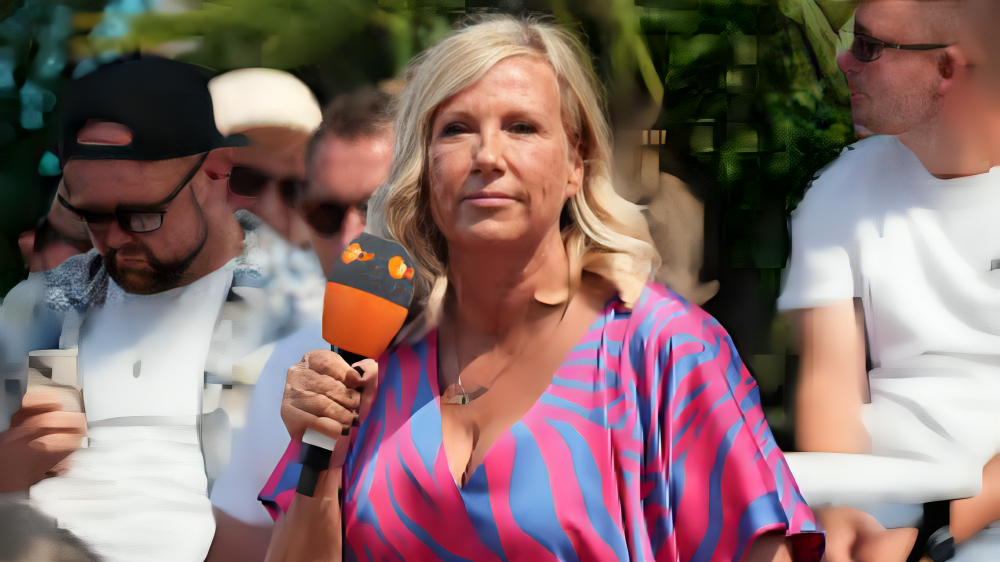
Andrea Kiewel engaging with the audience during a ZDF-Fernsehgarten episode.
Diverse Television Projects and Collaborations
Beyond ZDF-Fernsehgarten, Andrea Kiewel has hosted a smorgasbord of shows, showcasing her versatility. From 2000 to 2001, she led the game show Jede Sekunde zählt on ZDF, where every second counted in fun challenges. She co-hosted the Après-Ski-Show with Markus Wolfahrt, bringing alpine vibes to screens.
In 2004, Andrea ventured to Sat.1 for Kämpf um Deine Frau!, a social experiment format, and later hosted seasonal specials like Die Adventsshow, Die Herbstshow, and Die Frühlingsshow on ZDF. Her stint on MDR’s Riverboat in 2007 with Jan Hofer and Jörg Kachelmann added talk-show depth to her resume. From 2009 to 2011, she teamed up with lawyer Ralf Höcker for RTL’s Einspruch – Die Show der Rechtsirrtümer, debunking legal myths with humor.
More recently, Andrea has graced Willkommen 20xx, ZDF’s New Year’s Eve extravaganza at the Brandenburg Gate since 2013, and hosted Kiwis große Partynacht on Sat.1 from 2023 to 2024. These projects highlight her ability to adapt, always infusing positivity. As she puts it, variety keeps things fresh, like changing lanes in a long race.
Personal Life: Family, Relationships, and Home
Andrea Kiewel’s personal story is as compelling as her professional one. Married at 19, she welcomed her first son, Maximilian, in 1986. Maximilian has carved his own path, working as a journalist and now as Director for Defense & Military at Lufthansa. A brief marriage to editor Gerrit Brinkhaus in 1999 followed, then a union with director Theo Naumann from 2004 to 2007, who fathered her second son in 2001. Sadly, Naumann passed away in 2012.
Since 2017, Andrea has called Tel Aviv home, living with her Israeli partner, a former elite soldier. She identifies as Jewish and commutes to Germany for work, embracing a dual life that enriches her perspective. “Israel feels like home; it’s where my heart is,” she’s shared, highlighting her optimism amid global tensions.
Family remains her anchor. She often speaks warmly of her sons and mother, even addressing fears about aging parents with honesty. This blend of vulnerability and strength makes her relatable, proving that behind the TV smile is a real person navigating life’s waves.
Achievements, Awards, and Contributions
Andrea Kiewel’s trophy case sparkles with well-deserved honors. In 2006, she won the Goldene Henne for television, followed by another in 2009 for moderation. Her crowning achievement came in 2021 with the Deutscher Fernsehpreis for Best Moderation in Entertainment, affirming her expertise.
Beyond awards, Andrea’s contributions extend to authorship. Her 2006 book Mama, du bist nicht der Bestimmer offers parenting insights with humor, while 2020’s Meist sonnig – Eine Liebeserklärung an das Leben is a love letter to positivity. As a columnist for Super-Illu since 2005, she shares life lessons, building trust with readers.
Her philanthropy shines through charity shows like Gut zu wissen for Welthungerhilfe. These efforts underscore her authority in media, where she not only entertains but uplifts, making her a trusted figure in German households.
Navigating Controversies with Resilience
Like many public figures, Andrea Kiewel has faced storms, but she’s always bounced back stronger. In 2007, allegations of covert advertising for Weight Watchers led to a temporary contract termination with ZDF and MDR. She denied ties initially, but details emerged, teaching her about transparency.
In 2010, similar claims resurfaced, yet she returned triumphantly to ZDF-Fernsehgarten in 2009. More recently, in 2024, a necklace depicting Israel including occupied territories sparked debate; ZDF asked her to remove it, and she complied, later addressing it thoughtfully in interviews.
These moments, while challenging, highlight her growth. Andrea views them as learning opportunities, emerging with renewed optimism. “Life’s not perfect, but we keep swimming,” she’d likely say, turning setbacks into comebacks that inspire fans.
Recent Endeavors and Ongoing Impact
As of 2025, Andrea Kiewel remains a TV powerhouse. She announced her engagement live on ZDF-Fernsehgarten earlier this year, sharing joy with viewers.
Despite Middle East tensions affecting her travel from Tel Aviv, she returned triumphantly in June with surprises.
The show’s 2025 season kicked off in May with star guests, and she wrapped it in October, promising more fun ahead.
Andrea’s interviews, like one with Gregor Gysi in June, showcase her depth. Social media buzzes with her, from weight loss discussions to lighthearted blunders, proving her relevance.
Her influence extends beyond screens, encouraging positivity in uncertain times. Looking forward, Andrea’s future brims with potential—more shows, books, perhaps even international ventures.
Legacy and Inspiration in German Media
Andrea Kiewel’s mark on German television is indelible. Over three decades, she’s evolved from swimmer to star, embodying expertise through consistent excellence. Her authority comes from authenticity; trust, from openness about life’s joys and jolts.
She’s inspired countless women in media, showing that balancing career and family is possible with grit. In a fast-changing industry, her optimistic tone cuts through cynicism, reminding us to find sunshine even on cloudy days.
As Andrea Kiewel continues to host and innovate, her legacy grows, proving that true stars shine by lifting others up.
FAQs
What is Andrea Kiewel’s most famous TV show?
Andrea Kiewel is best known for hosting ZDF-Fernsehgarten since 2000, a lively open-air program featuring music, games, and celebrities that airs on Sundays.
How did Andrea Kiewel start her career?
She began as a competitive swimmer in the GDR, then transitioned to teaching before entering television in 1990 with Deutscher Fernsehfunk, eventually rising through various networks.
Where does Andrea Kiewel live now?
Since 2017, Andrea Kiewel has lived in Tel Aviv, Israel, with her partner, commuting to Germany for work while embracing her Jewish identity.
Has Andrea Kiewel won any awards?
Yes, she has received the Goldene Henne in 2006 and 2009, and the Deutscher Fernsehpreis in 2021 for her outstanding moderation in entertainment.
What books has Andrea Kiewel written?
She authored Mama, du bist nicht der Bestimmer in 2006, a humorous take on parenting, and Meist sonnig – Eine Liebeserklärung an das Leben in 2020, celebrating life’s positives.
Fazit
In wrapping up this exploration of Andrea Kiewel, it’s clear she’s more than a presenter—she’s a beacon of positivity in German entertainment. From her athletic youth to her commanding presence on ZDF-Fernsehgarten, Andrea Kiewel exemplifies how passion and perseverance can lead to a fulfilling life. Her story encourages us all to embrace change, learn from missteps, and spread joy. As she forges ahead in 2025 and beyond, Andrea Kiewel remains a trusted, expert voice, inspiring generations with her unwavering optimism.